






Why Are Boutique Brands Better in Wellness? What small companies, founder involvement and buying direct can preserve that scale often cannot
Share
Walk through almost any wellness aisle today and you’ll see the language of small, independent brands everywhere.
Small batch. Clean. Crafted. Founder-led. Thoughtfully sourced. Made with care.
There’s a reason those words have value.
The modern wellness industry was largely built by people who cared obsessively about something before there was necessarily a large market for it: herbalists, nutritionists, athletes, chefs, alternative-health practitioners and founders trying to solve problems in their own lives.
Then wellness became big business. And when something becomes big business, the incentives change. But boutique brands have one structural advantage that is difficult to manufacture at scale:
The people who care most about the product are often still the people making the decisions.
The economics of giving a shit
In a founder-led company, a strange thing happens. Decisions that make very little financial sense can survive. A more expensive ingredient stays because the founder thinks it tastes better.
A supplier doesn't get replaced because the cheaper version isn't quite as good.A manufacturing process remains inconvenient because changing it would alter the product.
A batch gets rejected because somebody who has been making the product for twenty years knows it isn't right. None of these decisions looks particularly impressive in a quarterly report. But collectively, they can be the difference between an exceptional product and an ordinary one.
Boutique quality is often the accumulation of tiny decisions that would never survive a corporate spreadsheet.
And this phenomenon isn't unique to wellness.
I'm from Malibu.
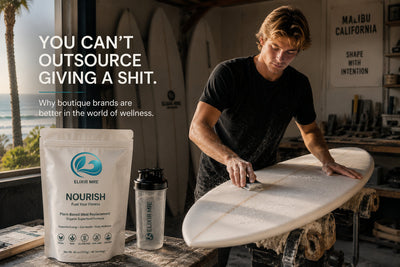
We see it in surfboards.
What surfboards can teach us about boutique brands
Surf culture understood founder-led products long before anybody started using the word “boutique.”
You knew who shaped your board.
The reputation of the shaper was attached to what you were riding.
Zuma Jay's Surfboards on Pacific Coast Highway is a great example. Jefferson “Zuma Jay” Wagner built his reputation in the same Malibu community where his boards were surfed. Decades later, he remains connected to the shop, the boards and the name over the door.
There is almost no distance between the product and the person whose reputation is attached to it.
Then there's Channel Islands.
I surf a 6'8" Channel Islands Thrasher with glassed-in fins, so this isn't an argument against Channel Islands. If anything, its history makes the point.
Al and Terry Merrick founded Channel Islands in 1969 and built it into one of surfing's most respected names. Burton Snowboards acquired the company in 2006.
But Channel Islands eventually found its way back.
In 2021, ownership moved to a privately held group led by Al Merrick's son Britt, along with Channel Islands employees, management and team riders.
That's an interesting arc.
A boutique surfboard company becomes an internationally recognized brand, gets acquired by a much larger company, and eventually returns to ownership involving the founder's family and the people who make, sell and ride the product.
Meanwhile, Zuma Jay stayed.
Different paths. Similar lesson.
In businesses built around craft, proximity matters.
Surf and clothing brands offer plenty of other examples. Companies born from a particular beach, neighborhood, sport or subculture grow, get acquired, expand internationally and gradually become more generic.
The logo survives.
The personality doesn't always survive with it.
What happens when a boutique brand becomes a corporate asset?
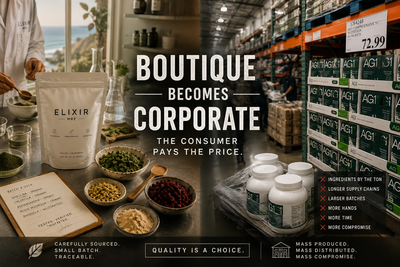
Usually, nobody walks into a meeting and says, “Let's make this product worse.” It happens one reasonable decision at a time.
A cheaper ingredient.
A larger supplier.
A faster manufacturing process.
A longer shelf life.
A few cents removed from packaging.
More SKUs. More distribution. More margin. Each decision may make perfect business sense. But make enough of them and eventually the product can become optimized for the corporation rather than the customer who originally loved it.
The brand remains boutique. The business behind it no longer is.
Buying independent matters
This is why buying from small companies and whenever possible, buying directly from those companies matters. You're doing more than keeping a small business alive. You're helping preserve a marketplace where unusual products can exist.
Products made with ingredients that might be too expensive for mass distribution.
Products manufactured in ways that aren't maximally efficient. Products designed for a specific customer rather than the largest possible demographic.
Products whose founders are still willing to say no.
When you buy directly from an independent company, more of that purchase stays with the people actually making the thing. That gives them something extraordinarily valuable:
the ability to keep making it their way.
Because efficiency naturally rewards standardization.
And sometimes the inefficiencies are where the good stuff lives.
The Elixir MRE experiment
Elixir MRE started in Malibu in 2003, long before plant-based wellness became the enormous consumer category it is today. We weren't trying to capture a trend.
We were trying to make products we wanted to exist. More than twenty years later, I'm still involved in what goes into them.
I know why ingredients were selected. I know why we've changed certain things and refused to change others. I know the manufacturing decisions behind the products because I was there when those decisions were originally made.
With Elixir MRE you have an institutional memory with a human being attached to it.
You can ask us why.
Why this ingredient?
Why this process?
Why not use the cheaper alternative?
Why haven't you changed something that would make manufacturing easier?
There is somebody here who remembers the answer. That's increasingly rare.
Are boutique wellness brands worth it?
Not simply because they're boutique. A small company can make a bad product just as easily as a giant corporation can make a great one.
So don't buy the word boutique.
Look behind it.
Who owns the company? Is the founder still involved? Who formulates the products? Where are they made? Why were those ingredients chosen? Has the formula changed? Can the company explain its sourcing?
And one question may tell you more than all the others:
What won't you compromise on?
Every company eventually gets an opportunity to make something cheaper, faster or easier. What it does at that moment tells you what kind of company it really is.
You can't outsource giving a shit
There's probably a more sophisticated way to say it. I'm just not convinced there's a more accurate one.
A surfboard shaper understands it.
A chef understands it.
A winemaker understands it.
And anyone who has spent twenty years making something and putting their reputation behind it understands it.
Craftsmanship isn't about rejecting growth, technology or scale.
It's about keeping somebody close enough to the product to notice when something changes and powerful enough to say no when it shouldn't.
That's why independent companies matter.
That's why buying directly from them matters.
And it's why remaining boutique doesn't necessarily mean a company failed to become enormous.
Sometimes remaining boutique is the point.
Because a brand isn't a logo, a trademark or an acquisition.
It's a promise somebody still has to give a shit about keeping.