







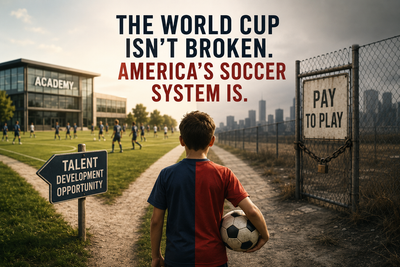

The World Cup Isn’t Broken. America’s Soccer System Is.
Share
Why can’t a country with 340 million people dominate the world’s most popular sport?
Every four years Americans ask that same question.
The answer has very little to do with athleticism, population, or even passion for the game.
It has everything to do with how we develop young players.
The United States has approximately 2.5 million registered youth male soccer players, more than the combined youth player pools of many traditional soccer powers.
Yet those countries consistently produce world class talent while the United States continues to underperform on the biggest stage.
That isn’t an accident.
It’s the system.
Europe Finds Talent. America Bills Parents.
In much of Europe, youth soccer follows a simple principle.
If a child shows exceptional talent, professional clubs come looking for them.
Scouts attend thousands of youth matches every year searching for players with potential. When they find one, that player enters a professional academy where coaching, facilities, travel, competition, and development are funded by the club.
Parents are not expected to finance a professional development pathway.
Talent is.
This model creates opportunity regardless of income.
America’s Pay to Play System
In America, the pathway looks very different.
Recreational soccer is relatively affordable.
The costs begin once a player shows promise.
Competitive travel soccer often costs around $6,000 per year.
Elite club soccer can easily reach $8,000 to $15,000 annually once travel, coaching, tournament fees, uniforms, equipment, hotels, transportation, and other expenses are included.
Some families report spending well over $20,000 each year trying to keep their child on the elite pathway.
Money becomes the gatekeeper.
Parents aren’t just paying enormous fees.
They’re committing weekends, vacations, countless road trips, and thousands of hours while balancing full time jobs and family responsibilities.
For many talented children, the obstacle isn’t ability.
It’s economics.
Germany Already Solved This Problem
Germany faced its own soccer crisis after a disappointing performance at the 2000 European Championship.
Instead of blaming coaches or players, the country rebuilt the entire development pipeline.
The German Football Association invested roughly €48 million annually into youth development.
It established approximately 390 regional training centers, ensuring nearly every talented child lived within about 25 kilometers of elite coaching.
More than 1,200 full time coaches were hired.
Professional clubs were required to operate certified youth academies or risk losing their Bundesliga license.
Families paid nothing.
Fourteen years later, Germany lifted the 2014 FIFA World Cup trophy.
Remarkably, 21 of the 23 players on that championship roster had developed through the reformed academy system.
The investment paid for itself.
But Don’t MLS Academies Already Do This?
Yes.
For the relatively small number of players who gain access.
Major League Soccer academies are free for those selected.
The challenge is scale.
MLS academies currently serve only a tiny fraction of America’s millions of youth soccer players, and they’re concentrated around MLS markets.
If you’re a gifted player growing up in rural Kansas, Mississippi, Montana, or hundreds of other communities without nearby academy access, the European pathway effectively doesn’t exist.
Your family either pays thousands of dollars every year…
Or your development stalls.
Talent shouldn’t depend on your ZIP code.
The Blueprint Already Exists
This isn’t an unsolved mystery.
Germany already proved that investing in youth infrastructure works.
The United States doesn’t need more motivational speeches.
It needs more scouts.
More regional academies.
More coaching.
More access.
Most importantly, it needs to stop asking parents to finance what should be a national player development system.
Until America develops talent based on ability instead of income, we’ll continue asking the same question every four years.
And we’ll keep getting the same answer.
Frequently Asked Questions
Why does the United States struggle in men’s soccer?
One major reason is the pay to play youth development model, which can limit access to elite coaching and competition for talented players from lower income families.
How much does elite youth soccer cost in America?
Competitive club soccer commonly costs between $8,000 and $15,000 per year once travel, tournaments, coaching, uniforms, and other expenses are included. Some families spend over $20,000 annually.
How do European soccer academies work?
Professional clubs identify talented players through scouting networks and provide coaching, education, facilities, travel, and competition at little or no cost to families.
What did Germany change after Euro 2000?
Germany invested heavily in youth coaching, regional training centers, and mandatory professional academies, creating one of the world’s most successful player development systems.
Should America eliminate pay to play soccer?
Many coaches and analysts argue that expanding publicly funded and club funded development pathways would allow talent, rather than family income, to determine which players reach the highest levels.
About Tom Gianelli
Tom Gianelli is the founder of Elixir MRE and the author of Quantum Entanglement: Everything Is Because of Love, now being adapted for film and a limited television series. He is also producing a documentary about the true story behind Elixir MRE, tracing how profound love, devastating grief, resilience, and the pursuit of healing transformed personal tragedy into a lifelong mission. Whether writing, filmmaking, or developing nutritional wellness products, his work explores one central question: how love shapes the human experience.