






Why We Trust Million-Dollar Brands Before Our Friends
Share
Buy Products From Your Friends. Get Free Stuff From Strangers.
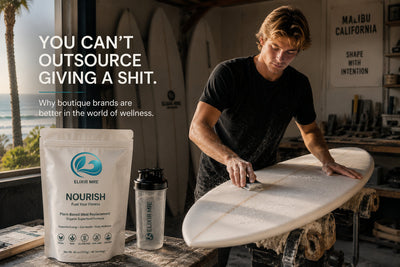
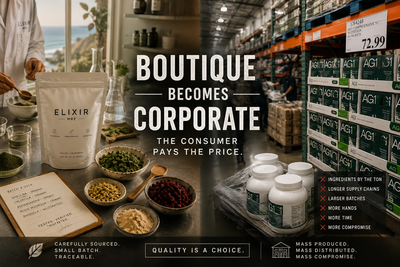
Before I make this point, let me be clear: I believe boutique nutrition companies produce a fundamentally different class of product than mass-market supplement brands. Many large supplement companies rely on contract manufacturers, standardized production lines, and large ingredient supply chains designed to produce products at enormous scale. Boutique companies, by contrast, often have greater control over ingredient sourcing, formulation, quality standards, and batch oversight because they're building a reputation, not just market share. It's the difference between a Ferrari and a Ford. Both may get you where you're going, but one is built around craftsmanship while the other is built around mass production.
Elixir MRE is produced in a private facility using carefully selected organic ingredients under standards we've spent decades refining. We don't formulate for the lowest cost or the widest margin. We formulate for the highest quality product we know how to make.
I walked into a friend’s house not long ago and noticed a familiar green container sitting on the kitchen counter.
It wasn’t Elixir.
It was AG1.
Now, this isn’t a criticism of AG1. They’ve built an extraordinary company. They deserve enormous credit for creating one of the most recognizable wellness brands in the world. Millions of people trust them. Professional athletes endorse them. Influencers recommend them. They’re everywhere you look.
That’s what successful companies do.
But standing there, I found myself thinking less about the product and more about something much bigger.
Why do people trust billion-dollar brands before the people they actually know?
Consumer psychologists have studied this question for decades. The answer usually comes down to three things: social proof, familiarity, and perceived authority. When millions of people buy a product, our brains assume someone else has already done the homework. It feels safer to follow the crowd than to evaluate every purchase from scratch.
That’s a useful shortcut. But popularity and quality aren’t the same thing.
And that’s where I think we’ve lost something important.
We’ll happily hand our credit card to a corporation whose CEO we’ve never met, whose products we’ve never seen manufactured, and whose advertising budget is larger than the GDP of some countries.
Yet when someone we know spends years writing a book, opening a restaurant, launching a business, inventing a product, directing a film, or creating something they genuinely believe can improve people’s lives, our first instinct is often skepticism.
Or worse...
“Can you hook me up?”
I’ve always found that fascinating.
Why Do We Trust Big Brands More Than Small Businesses?
Large companies don’t just sell products. They sell certainty.
Professional photography.
Celebrity endorsements.
Massive advertising campaigns.
Beautiful packaging.
Millions of existing customers.
Every one of those things quietly tells our brain:
“This must be good because everyone else already bought it.”
Psychologists call this social proof, our tendency to look to other people’s behavior when deciding what to do ourselves. Most of the time, that’s perfectly reasonable. But it’s also why genuinely great products often struggle in the beginning.
Every iconic company was once unknown.
Every bestselling author had no readers.
Every famous restaurant served its very first customer.
Every breakthrough invention started with someone willing to believe before everyone else did.
Innovation has never begun with popularity.
Popularity follows innovation.
Why We Undervalue the People We Know
Here’s the irony. We often judge strangers by their accomplishments. We judge friends by our memories. Maybe they’re still the kid we went to high school with.
The coworker from fifteen years ago.
The neighbor down the street.
The guy who used to surf every morning.
The woman who started her business in a spare bedroom.
Because we know where they started, we sometimes struggle to appreciate how far they’ve come.
Meanwhile, strangers arrive fully packaged.
Their websites are polished.
Their branding is flawless.
Their Instagram is beautiful.
Their endorsements create instant authority.
Marketing fills in the gaps that familiarity leaves exposed.
Should You Buy From a Friend’s Business?
Not because they’re your friend. Because they deserve the same opportunity you would gladly give a complete stranger.
Read the book.
Try the product.
Visit the restaurant.
Watch the film.
Hire the contractor.
If it’s excellent, support it.
Businesses earn trust the same way relationships do, by consistently delivering on their promises.
No one deserves blind loyalty.
But everyone deserves a fair evaluation.
Why Asking Small Businesses for Discounts Hurts More Than You Think
This is the part I wish more people understood. Large corporations build discounts into their pricing models. They spend billions of dollars every year acquiring customers.
Free shipping.
Coupon codes.
Referral bonuses.
Twenty percent off.
Buy one, get one free.
Those aren’t favors. They’re marketing budgets.
Small businesses don’t have those budgets. Behind every product sitting on a shelf are years of invisible work.
Late nights.
Failed experiments.
Personal sacrifices.
Empty bank accounts.
Research.
Testing.
Manufacturing setbacks.
Packaging redesigns.
Customer service.
Payroll.
Inventory.
Shipping.
The entrepreneur isn’t asking for sympathy.
They’re asking for the chance to survive long enough to become the company everyone eventually trusts.
Ironically, it’s often strangers who become those first believers.
Why Supporting Small Businesses Matters
Every purchase is more than a transaction. It’s a vote. A vote for craftsmanship over convenience. For entrepreneurship over complacency.
When you buy from a responsible small business, you’re often supporting a family, a dream, years of hard work, and the next chapter of someone’s life.
That purchase usually matters far more than it would to another multinational corporation. One customer may not matter much to Nike.
It matters enormously to someone building their company one order at a time.
Buy Products From Your Friends. Get Free Stuff From Strangers.
If you want free stuff...
Ask Nike.
Ask Amazon.
Ask Costco.
Ask the companies spending billions of dollars acquiring customers.
Don’t ask the person risking everything to build something they believe in.
If you genuinely believe in your friend’s work, support it the same way you’d support any company you admire.
Pay for the product.
Read the book.
Leave an honest review.
Recommend it if you love it.
Share it with someone else.
Those simple actions can change the trajectory of a small business. Maybe we’ve had it backwards all along.
We spend thousands of dollars every year with companies that don’t know our names...
...while hesitating to support the people sitting across the dinner table from us.
The next time someone you know launches a business, publishes a book, opens a restaurant, releases a film, starts a nonprofit, invents a product, or creates something they believe can make the world a little better, don’t ask for the discount.
Ask how you can help.
Buy products from your friends.
Get free stuff from strangers.
I have a feeling we’d all be better off if we remembered the difference.
Frequently Asked Questions
Why do people trust large brands more than small businesses?
Consumers naturally rely on social proof, familiarity, and perceived authority. Large brands feel safer because millions of people have already purchased their products, but popularity doesn’t always reflect quality.
Should I support my friend’s business?
Evaluate your friend’s business the same way you would evaluate any other company. Give it an honest opportunity, judge the product on its merits, and support it if it delivers value.
Why do friends ask for discounts?
Familiarity often creates the expectation of special treatment. Ironically, small businesses usually have the least financial flexibility to offer discounts because they operate with much tighter margins than large corporations.
Is it better to buy from small businesses?
Small businesses often provide more personalized service, founder involvement, unique products, and stronger community impact. Consumers should evaluate businesses based on quality, transparency, and integrity—not simply their size.
How does social proof affect buying decisions?
Social proof is a psychological shortcut that helps reduce uncertainty. People often assume products with many customers or celebrity endorsements are superior, even though those signals don’t always reflect product quality.
Why is supporting entrepreneurs important?
Entrepreneurs create products, services, jobs, and innovation by taking significant personal and financial risks. Supporting responsible entrepreneurs strengthens local economies and encourages future innovation.
What makes boutique nutrition companies different?
Many boutique nutrition companies emphasize ingredient sourcing, formulation quality, transparency, and founder oversight rather than mass production and advertising. Company size alone doesn’t determine product quality.
What is Elixir MRE’s philosophy?
Elixir MRE believes that long-term health is built through consistency, real ingredients, transparent formulations, and science-driven nutrition, not hype, celebrity endorsements, or wellness trends.
About Tom Gianelli
Tom Gianelli is the founder of Elixir MRE and the author of Quantum Entanglement: Everything Is Because of Love, now being adapted for film and a limited television series. He is also producing a documentary about the true story behind Elixir MRE, tracing how profound love, devastating grief, resilience, and the pursuit of healing transformed personal tragedy into a lifelong mission. Whether writing, filmmaking, or developing nutritional wellness products, his work explores one central question: how love shapes the human experience.