






What Happens When Your Wellness Brand Sells Out?
Share
Your Favorite Wellness Brand Got Acquired. Now Read the Label... It May Have Changed.
There is a familiar life cycle in the wellness business. Someone creates a good product because they believe in it. Ingredients are carefully sourced, production is relatively small, and the people making it know exactly what is going into the bag or bottle.
Then people discover it.
The company grows, investors arrive, distribution expands and eventually the wellness product you once had to seek out is sitting on a pallet at Costco.
This is generally described as success.
I'm not sure it always is.
This week, Procter & Gamble agreed to acquire Thorne for $3.8 billion. Thorne spent years developing a reputation as a serious supplement company, trusted by physicians, athletes and people who actually read ingredient labels.
That doesn't mean P&G is going to ruin Thorne. It does mean Thorne will operate under a different set of incentives.
A founder can choose an expensive ingredient because they think it's better. A multinational corporation has procurement departments, production targets, retail margins and shareholders.
At sufficient scale, three cents matters.
We've seen this progression throughout wellness. Garden of Life and Nuun became part of Nestlé Health Science. Bloom brought in major institutional investment. AG1 went from an insider subscription product to a global wellness business.
This isn't necessarily sinister. It's capitalism.
But consumers should understand what happens when a boutique wellness product becomes a mass-market product.
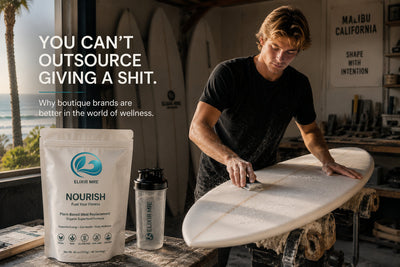
There is a sweet spot when a company is large enough to manufacture professionally but still small enough to be obsessive. The founders know the suppliers. Ingredients can be selected for quality rather than simply availability at enormous volume. Production can remain relatively small and traceable.
Then comes scale.
And scale changes things.
There is also something the wellness business doesn't particularly like admitting: ubiquity destroys exclusivity.
If something is rare, difficult to find and made in limited quantities, we call it boutique. If the same thing is available at Target, Costco and every supermarket in America, we call it successful.
But we probably shouldn't still call it elite.
Ferrari understands this. Hermès understands it. Luxury has always understood that scarcity can be part of value.
Wellness seems determined to forget it.
What Happens After the Founder Era?
This is where the difference becomes physical.
A founder-led wellness company might buy an ingredient from a grower or supplier it knows and send it to a trusted third-party manufacturer for small, traceable production runs. Storage, packaging and transportation can remain relatively controlled because the supply chain is manageable.
Now try doing that for 20 million customers.
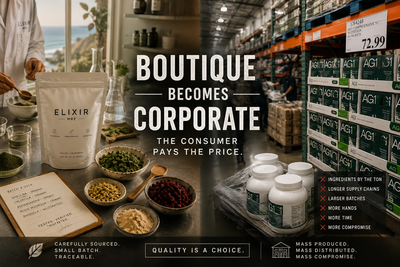
At mass-market scale, ingredients increasingly enter global commodity supply chains. Spirulina, chlorella, plant proteins, herbs, mushrooms and other superfood ingredients can be purchased by the ton, consolidated through large distributors and manufactured in facilities serving many brands.
Small batches become large production runs. Ingredients move through industrial mixers, filling lines, warehouses, pallets, trucks and distribution centers. Products may spend months moving through a supply chain before reaching the consumer.
Large-scale manufacturing isn't inherently bad. Major manufacturers can have exceptional laboratories, testing and quality-control systems.
But it isn't the same thing.
A carefully sourced ingredient, protected from heat and moisture and manufactured in a traceable small batch is fundamentally different from buying a specification by the ton and building a supply chain capable of keeping thousands of retail shelves stocked.
And there are reasons consumers should keep paying attention after an acquisition.
Garden of Life became part of Nestlé through its acquisition of Atrium Innovations in 2017. At the time, Garden of Life told customers that Nestlé would not change what the company did or stood for.
Years later, Consumer Reports testing found 2.76 micrograms of lead in a serving of Garden of Life Sport Organic Plant-Based Protein. A subsequent lawsuit characterized that result as roughly 564 percent of the benchmark cited in the complaint. Garden of Life contested the allegations, and the lawsuit was ultimately dismissed with prejudice.
That finding does not prove Nestlé caused the problem. It doesn't prove the acquisition changed the product. It proves something more useful to consumers:
Never let a familiar logo do your due diligence for you.
The anxiety isn't confined to wellness writers or industry insiders. Supplement communities on Reddit routinely erupt after acquisitions, with longtime customers comparing labels, questioning sourcing and searching for independent alternatives. Some consumers assume quality will decline; others rightly demand evidence before making that claim. Both reactions point to the same thing: when ownership changes, trust gets renegotiated.
Ownership changes. Suppliers can change. Manufacturing can change. Formulas can change. The product inside the package can change.
The logo usually doesn't.
Once volume becomes the objective, the questions change too. Can an ingredient be sourced for less? Can shelf life be extended? Can another supplier meet the specification? Can production run faster? Can packaging cost three cents less? Can gross margin improve two points?
Each decision sounds insignificant.
Together, they can turn an artisanal product into an industrial one.
So the question I ask when a boutique wellness product suddenly appears everywhere isn't whether the company has become successful.
It's whether the product has remained special.
Who owns it now? Who invested in it? Where are the ingredients sourced? Has the formula changed? Has the manufacturing changed? Is this still the product people originally fell in love with?
Or are we buying the name they remember?
In wellness, bigger isn't necessarily better.
Sometimes the real luxury is knowing who made your product, where the ingredients came from, and why they chose them.
Maybe boutique isn't what wellness grows out of.
Maybe boutique is the point.